
Selecting parallel thread rolling and upsetting equipment for ASTM A615 and SASO standard rebar in Saudi infrastructure, high-rises, and industrial foundations.
In civil and industrial engineering across Saudi Arabia—from water transmission pipelines and bridge overpasses to stadium foundations and high-rise developments—reinforcing steel specifications are governed primarily by ASTM A615 (Grade 60 and Grade 75) and SASO standards. To eliminate rebar congestion in massive concrete sections and ensure rapid erection, project engineers widely mandate mechanical coupler splicing.
Achieving structural compliance under ACI 318 Type 1 and Type 2 mechanical splice specifications requires precision rebar processing equipment capable of handling high-tensile rebar without compromising metallurgy. This guide provides technical criteria for selecting rebar peeling, forging, and thread rolling machines built by National Cutting Tools for Saudi steel yards.
1. Metallurgy Considerations for ASTM A615 Grade 60 & 75
ASTM A615 reinforcement features high carbon equivalent chemistries designed for high yield strength ($\ge 420 ext{ MPa}$ for Grade 60, $\ge 520 ext{ MPa}$ for Grade 75). When processing these hard alloy bars, machine design must address several distinct physical realities:
- High Surface Hardness: Peeling toolholders must utilize heavy-duty carbide cutting inserts with negative rake geometry to slice cleanly through hardened outer deformed ribs without tool chipping.
- Work-Hardening Sensitivity: During thread rolling, excessive roll deformation can cause microscopic surface fissures if roll geometry is incorrect. Precision hardened thread rolls with progressive entry profiles ensure smooth plastic flow.
- Dimensional Tolerances: Consistent thread pitch and flank angle ($60^\circ$ ISO Metric) are essential to ensure full thread engagement with certified rebar couplers.
Our industrial rebar threading machine incorporates high-rigidity spindle bearings and heavy cast iron headstocks that absorb high cutting forces without deflection, maintaining class 6g thread tolerances.
2. Cold Forging (Upsetting) for ACI 318 Type 2 Seismic Splices
Saudi building codes frequently require mechanical splices in seismic design categories to achieve Type 2 performance (developing at least 125% of the specified yield strength and 100% of the specified tensile strength of the bar). Meeting this requirement on ASTM A615 rebar cannot be left to standard cut threads.
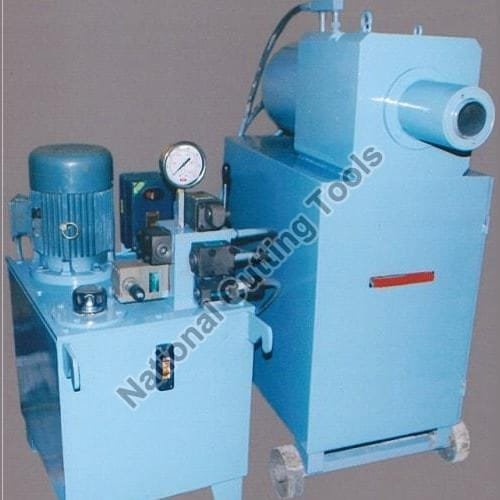
The rebar cold forging machine addresses this by hydraulically upsetting the bar end:
- The rebar end is inserted into heavy hydraulic split dies.
- A high-tonnage hydraulic cylinder applies longitudinal upsetting pressure, expanding the cross-sectional area by 15% to 20% over a 100 mm to 150 mm zone.
- Parallel threads are subsequently rolled into this expanded section. Because the minor root diameter of the rolled thread remains larger than the nominal parent bar diameter, tensile fracture during laboratory proof testing occurs in the free bar, never at the threaded joint.
3. Production Line Layout for a Saudi Rebar Yard
A productive rebar cut-and-bend yard processing 30 to 50 tons of rebar daily typically configures a dedicated parallel processing bay:
| Equipment Station | Function | Processing Capacity | Power & Motor |
|---|---|---|---|
| Shear Line / Band Saw | Square cut bar ends | Bundle cutting (up to 40mm) | 7.5 kW / 60 Hz |
| Cold Forging Press | Hydraulic end upsetting | 40 – 60 ends / hour | 11 kW / 60 Hz Hydraulic |
| Automatic Thread Roller | Peel & roll parallel thread | 70 – 90 ends / hour | 4.0 kW + 5.5 kW / 60 Hz |
| Quality Inspection Bench | Go/No-Go pitch & caliper check | 100% batch sampling | Manual inspection |
For high-volume continuous yards, paired batteries of our steel bar threading machine ensure balanced output matching the shear line speed.
4. Electrical Compatibility for Saudi Industrial Zones
Machinery exported to Saudi Arabia is built with 380V, 3-Phase, 60 Hz heavy-duty industrial electrics. All hydraulic power packs, coolant pumps, and spindle drive motors utilize Class H or Class F insulation to handle continuous duty cycles in unconditioned fabrication sheds where ambient temperatures reach 45°C to 50°C during peak summer months.
5. Export Support & Spares Provisioning
National Cutting Tools ships rebar machinery complete with spare chasers, thread rolling dies, hydraulic seals, and calibrated inspection gauges. To discuss machinery configurations for upcoming civil contracts in Riyadh, Dammam, or Jeddah, consult our Saudi Arabia export hub, review our rebar machinery portfolio, or request technical literature through our contact desk.
Machines covered in this guide
Senior Machine Tool Design & Production Engineering Division, Ludhiana Works
Authored by machine tool builders at our Ludhiana manufacturing works. Every technical parameter, metallurgy guideline, electrical formula, and production cycle stated in this guide is reviewed by our shop-floor engineers who assemble, wire, and execute material trials before global dispatch to GCC and domestic manufacturing facilities.
Need Engineering Consultation on This Subject?
Speak directly with National Cutting Tools senior machinery engineers.