
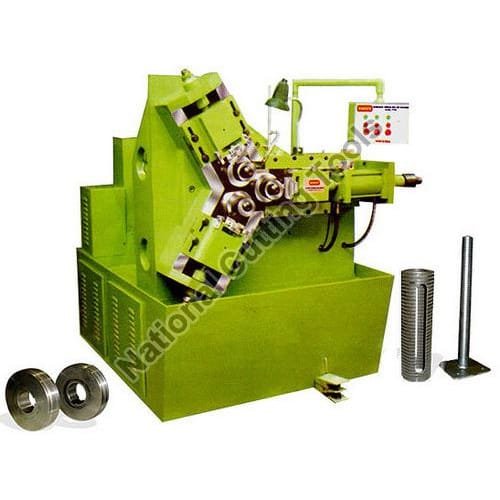
Technical analysis of 3-roll hydraulic thread rolling machine operation, cold plastic deformation mechanics, grain flow integrity, and die pitch synchronization for construction tie rods.
Formwork tie rods (15/17 mm and 20/22 mm Dywidag type), foundation anchor bolts (M16 to M48), and adjustable scaffolding jack screws are safety-critical structural fasteners. When concrete is poured into column or wall formwork, hydrostatic pressure exerts immense tensile loads on tie rods. Any failure or thread stripping causes catastrophic shuttering blow-outs.
Traditional thread cutting on lathes or chasers severs the continuous longitudinal grain structure of the steel bar, creating microscopic stress risers at every thread root. Cold thread rolling on a three-roll hydraulic machine avoids this hazard completely by displacing metal plastically into the die profile.
Cold Plastic Deformation & Grain Flow Integrity
During thread rolling, hardened circular alloy steel dies (D2 or D3 tool steel vacuum hardened to 60-62 HRC) penetrate into the cylindrical bar blank under controlled hydraulic pressure. Instead of cutting metal away as chips, the steel in the root zones is compressed and forced upward into the crests.
This cold working process yields three decisive structural benefits:
- Unbroken Grain Flow: Steel grain lines curve smoothly over the thread profile without interruption, increasing tensile yield strength by 10% to 15%.
- Work Hardened Surface: Cold compression increases root surface hardness by 15% to 20%, dramatically improving wear resistance against repeated wing nut tightening.
- Zero Metal Scrap: Because threads are formed by displacement, bar blank diameter is turned to the pitch diameter rather than the full outer crest diameter, saving 15% to 20% raw steel mass on every bar.
Why 3-Roll Geometry Outperforms 2-Roll on Hollow & Long Bars
In a standard 2-roll machine, the workpiece is held between two roller dies and rests on a support blade. Under heavy rolling tonnage, the bar experiences high asymmetric downward force, which can cause hollow scaffolding pipes or thin-wall tubes to crush or lose roundness.
In National Cutting Tools Three-Roll Hydraulic Thread Rolling Machines, the three synchronized roller dies are positioned at 120-degree radial intervals around the workpiece. The three equal radial forces balance each other perfectly, providing self-centering support that prevents tube ovality and allows flawless threading of both solid structural bars and hollow tubes.
Hydraulic Tonnage Sizing Matrix
| Thread Profile & Bar Size | Material Grade | Recommended Hydraulic Tonnage | Rolling Cycle Time |
|---|---|---|---|
| 15/17 mm Formwork Tie Rod (10 mm Pitch) | EN8 / High Tensile Steel | 20 to 25 Tons | 4 to 6 seconds per meter (through-feed) |
| M24 to M36 Foundation Anchor Bolts | IS 2062 / EN9 Steel | 25 to 30 Tons | 5 to 8 seconds per end (in-feed) |
| 38 mm OD Adjustable Scaffolding Jack Screws | Mild Steel Solid / Heavy Tube | 15 to 20 Tons | 6 to 9 seconds per meter |
Inspect our running thread rolling machines on your own bar material at our Ludhiana works. Contact our engineering desk at +91-9888210800 to book a trial run.
Senior Machine Tool Design & Production Engineering Division, Ludhiana Works
Authored by machine tool builders at our Ludhiana manufacturing works. Every technical parameter, metallurgy guideline, electrical formula, and production cycle stated in this guide is reviewed by our shop-floor engineers who assemble, wire, and execute material trials before global dispatch to GCC and domestic manufacturing facilities.
Need Engineering Consultation on This Subject?
Speak directly with National Cutting Tools senior machinery engineers.