
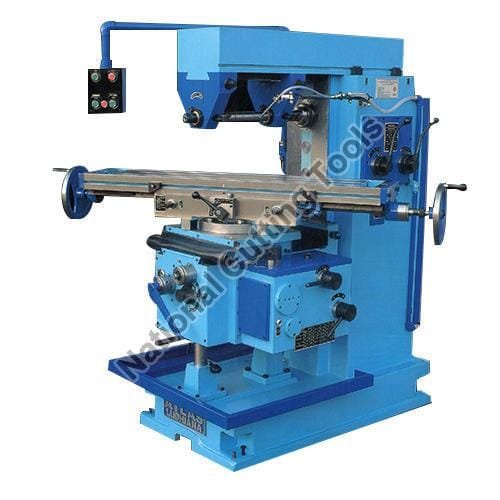
A comprehensive engineering guide on selecting industrial milling machines. Compares all-geared horizontal universal mills and vertical turret mills. Covers ISO 40 vs ISO 50 tapers, dovetail vs box guideways, table load capacities, and motor sizing.
Selecting Industrial Milling Machinery for Heavy Metalworking
Milling machines are the workhorse of general engineering workshops, toolrooms, and structural fabrication lines. Whether facing flat flanges, cutting keyways in heavy transmission shafts, or machining complex multi-surface casting bodies, selecting the correct mill architecture directly governs cutting rigidity, cycle efficiency, and dimensional accuracy.
National Cutting Tools manufactures heavy-duty all-geared universal milling machines and vertical turret milling machines in Ludhiana. This guide outlines the key structural and mechanical parameters fabricators must evaluate before acquiring a milling unit.
1. Machine Architectures: Universal vs Vertical vs Turret
Understanding the kinematic differences between milling configurations is fundamental:
- All-Geared Universal Milling Machines: The table can swivel horizontally (typically up to ±45°) to cut helical gears, spiral flutes, and complex worms when coupled with a universal dividing head. Equipped with an overarm and arbor supports for horizontal slab milling, as well as a heavy-duty vertical milling head attachment. Designed for heavy stock removal on steel billets and forging blocks.
- Vertical Turret Milling Machines: Feature an articulating quill head mounted on an overarm ram that slides forward, backward, and swivels 360°. Highly flexible for drilling, boring, and face milling at compound angles. Best suited for die and mould toolrooms and repair facilities.
- Fixed Bed Type Milling Machines: The table moves strictly along the X-axis on a heavy rigid foundation bed while the column or spindle carrier handles Y and Z axes. Delivers the highest vibration damping for large structural plates and multi-ton castings.
2. Spindle Taper: ISO 40 vs ISO 50
The spindle taper determines cutting torque transmission and maximum tool shank rigidity:
- ISO 40 (NT 40 / BT 40): Standard for medium-duty vertical and turret mills. Handles face mills up to 100 mm diameter and end mills up to 32 mm. Ideal for alloy steel tooling, jig fixtures, and general engineering cuts requiring spindle speeds up to 1800–2400 RPM.
- ISO 50 (NT 50 / BT 50): Essential for heavy universal and bed-type mills. Features a massive spindle nose diameter (128.57 mm gauge) designed to transmit up to 7.5 kW to 15 kW of continuous low-speed torque without spindle twist. Accommodates 160 mm to 250 mm face milling cutter bodies running heavy carbide inserts in structural steel (IS 2062, EN-8, EN-19).
3. Guideway Construction: Box Ways vs Dovetail
Rigidity under heavy intermittent cutting forces depends on the machine slide geometry:
| Feature | Dovetail Guideways | Hardened Square Box Ways |
|---|---|---|
| Primary Contact Area | Angled contact surfaces with single gib strip | Wide 3-sided bearing contact with twin gibs |
| Vibration Damping | Moderate (suitable for fine finish cuts) | Superior (absorbs interrupted milling shock) |
| Max Table Load | 250 kg – 450 kg | 800 kg – 2500 kg |
| Typical Application | Turret mills, toolroom operations | Heavy universal mills, production gang milling |
4. Feed Drive Systems: Rapid Traverses and Power Feeds
Manual cranking on large milling tables introduces operator fatigue and uneven feed rates that degrade surface finish. NCT universal mills incorporate independent motorized feed gearboxes or AC servo drives on X, Y, and Z axes:
- Longitudinal (X) Power Feed: 8 to 18 mechanical gear changes providing feed rates from 12 mm/min to 600 mm/min, with rapid traverse (1200–1800 mm/min) to minimize non-cutting return stroke time.
- Cross (Y) & Vertical (Z) Feeds: Automatic feeds on knee elevation eliminate physical strain when clearing heavy cutter assemblies.
- Backlash Eliminator: Split nut arrangements on lead screws allow both conventional up-milling and climb down-milling without table snatching.
5. Equipment Specification Recommendations
When requesting proposals from our milling machinery division, provide workpiece dimensions, weight, raw stock hardness (BHN), and desired daily component volume. Our Ludhiana factory manufactures units with custom table lengths up to 2000 mm, digital readout (DRO) integrations on 3 axes, and dual-voltage electrical configurations (380V/415V/440V, 50/60 Hz) for seamless overseas deployment in the UAE, Saudi Arabia, and GCC industrial hubs.
Senior Machine Tool Design & Production Engineering Division, Ludhiana Works
Authored by machine tool builders at our Ludhiana manufacturing works. Every technical parameter, metallurgy guideline, electrical formula, and production cycle stated in this guide is reviewed by our shop-floor engineers who assemble, wire, and execute material trials before global dispatch to GCC and domestic manufacturing facilities.
Need Engineering Consultation on This Subject?
Speak directly with National Cutting Tools senior machinery engineers.