
Critical electrical, duty cycle, and mechanical considerations when procuring 380V/220V 60Hz scaffolding welding lines and power presses for Saudi industrial fabricators.
Under Saudi Vision 2030, massive giga-projects across the Kingdom of Saudi Arabia—including NEOM, the Red Sea Project, Qiddiya, and residential expansions across Riyadh and the Eastern Province—have triggered immense domestic demand for certified scaffolding. Local steel and scaffolding fabricators in Dammam 2nd Industrial City, Sudair, and Jeddah are expanding in-house manufacturing to qualify for local content programs (Iktva).
However, importing industrial machinery into Saudi Arabia requires strict attention to unique electrical grid characteristics and thermal requirements. Operating Indian or European machinery built for 50 Hz without proper engineering adaptation leads to premature motor burnout, incorrect cycle timing, and regulatory rejection. This guide explains how National Cutting Tools engineers machinery specifically for the Saudi market.
1. The 60 Hz Frequency Factor: Why Direct 50 Hz Machinery Fails in KSA
Saudi Arabia operates on a 60 Hz grid frequency (primarily 380V 3-Phase in industrial zones, with legacy 220V 3-Phase in older facilities). Running standard 50 Hz induction motors on a 60 Hz electrical supply without engineering adjustments produces serious operational problems:
- 20% Higher Rotational Speed: Motor speed is directly proportional to frequency (N = 120f / P). A 50 Hz motor runs 20% faster on a 60 Hz supply (e.g., 1440 RPM increases to ~1725 RPM). In mechanical power presses or rotary welding positioners, this causes excessive flywheel kinetic energy, uncontrolled ram acceleration, and rapid mechanical wear.
- Hydraulic Pump Over-Speed & Cavitation: Hydraulic pumps driven 20% faster deliver excessive flow rates, resulting in fluid overheating, oil foaming, valve chatter, and seal degradation.
- Voltage/Frequency Imbalance: Running motors without matching V/f ratios causes core saturation, excessive current draw, and winding burnout under sustained ambient temperatures.
Every machine manufactured for Saudi export by National Cutting Tools—from our standard Ringlock welding machine to our C-frame power press—features motors, gear ratios, and hydraulic pumps specifically calculated and wound for 380V / 60 Hz operation.
2. Core Scaffolding Machinery Built for Saudi Yards
Saudi contractors supply heavy scaffolding systems capable of withstanding extreme site handling. Fabricating these modular systems requires three core production lines:
A. Ringlock Rosette Automatic Welding Systems
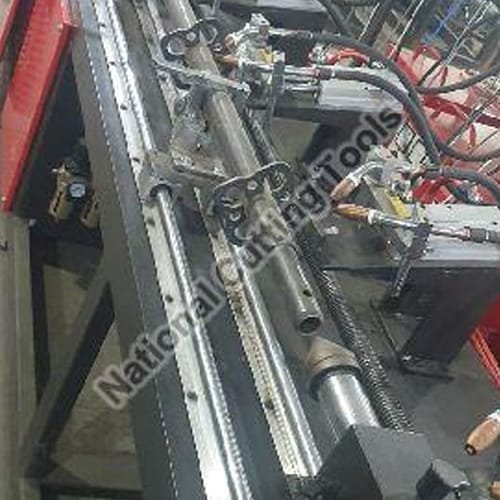
Because Ringlock scaffolding is widely preferred across Saudi Aramco and SABIC facilities for its rigid node connection, local fabricators utilize the standard Ringlock welding machine. Equipped with multi-torch water-cooled MIG power sources, pneumatic tube clamping, and automatic indexing along 0.5m to 3.0m vertical standards, it produces complete, uniform welds around rosettes in less than 25 seconds per station.
B. Scaffolding Thread Rolling for Jacks & Props
Adjustable base jacks and heavy shoring props require deep, coarse trapezoidal or acme threads. The scaffolding thread rolling machine cold-rolls threads directly onto hollow ERW structural pipes (38 mm to 60 mm OD) without removing metal, resulting in higher fatigue strength and smoother collar nut travel than cut threads.
C. Hydraulic Component Stamping Presses
Stamping ledger blades, top cups, and rosette discs from thick structural plate requires high-tonnage mechanical and hydraulic presses. Explore our double action deep drawing hydraulic press for cupping operations and pillar type power press for high-speed blanking.
3. Engineering Specifications for KSA Delivery
The table below summarizes standard build parameters for National Cutting Tools machinery shipped to Saudi Arabia:
| Parameter | Saudi Standard Requirement | NCT Factory Implementation |
|---|---|---|
| Supply Voltage | 380V (±10%), 3-Phase | Class H insulated copper wound motors |
| Grid Frequency | 60 Hz | Gearboxes & pulleys geared for exact 60Hz speeds |
| Ambient Rating | Up to 50°C ambient | Forced air cooling, heavy oil coolers on hydraulics |
| Control System | 24V DC safety circuits | Schneider / Siemens switchgear with thermal relays |
| Standards Conformity | SASO / CE compatible | Safety emergency stop circuits and interlocking guards |
4. Shipping Routes to Dammam, Jeddah & Riyadh Dry Port
Sea freight dispatches from our factory in Ludhiana, Punjab, connect directly with major Saudi commercial ports:
- Dammam (King Abdulaziz Port): Serving Eastern Province fabrication yards in Dammam, Jubail, and Khobar with direct container liner services from Mundra / Nhava Sheva.
- Jeddah Islamic Port: Serving Western Province yards in Jeddah, Rabigh, and Yanbu.
- Riyadh Dry Port: Direct intermodal rail bills of lading via Dammam for fabricators in Sudair and Riyadh Industrial Cities.
5. Factory Acceptance Testing (FAT) & Inquiries
We welcome Saudi procurement engineers and third-party inspection teams (TPI) to witness live material run-off trials at our Ludhiana works prior to export container loading. Review our complete Saudi Arabia machinery market hub, inspect our scaffolding machinery line, or contact our engineering desk via the official RFQ portal.
Machines covered in this guide
Senior Machine Tool Design & Production Engineering Division, Ludhiana Works
Authored by machine tool builders at our Ludhiana manufacturing works. Every technical parameter, metallurgy guideline, electrical formula, and production cycle stated in this guide is reviewed by our shop-floor engineers who assemble, wire, and execute material trials before global dispatch to GCC and domestic manufacturing facilities.
Need Engineering Consultation on This Subject?
Speak directly with National Cutting Tools senior machinery engineers.