
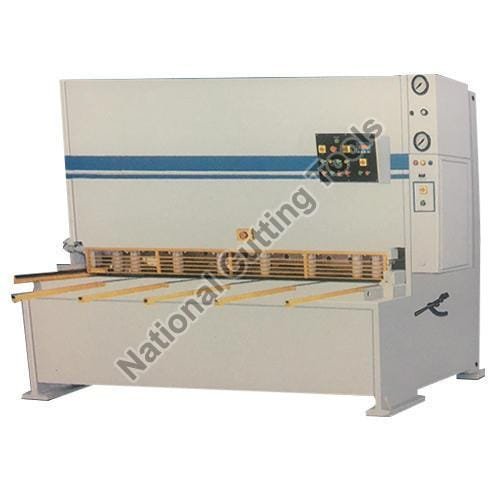
An authoritative engineering manual on hydraulic plate shearing machines. Explains guillotine vs swing beam kinematics, rake angle calculation, blade clearance percentages for mild and stainless steel, and backgauge accuracy.
Industrial Sheet and Plate Shearing Technology
In sheet metal fabrication, heavy structural tank manufacturing, pre-engineered building (PEB) plants, and industrial equipment enclosures, hydraulic plate shearing machines convert raw coil and mill plates into precision blanks. Achieving burr-free edges, straight shearing lines, and zero plate twisting requires an exact understanding of cutting kinematics, blade clearances, and hydraulic holding pressures.
National Cutting Tools manufactures both hydraulic guillotine shearing machines and hydraulic swing beam shearing machines in Ludhiana. This guide provides actionable technical principles for production managers specifying shearing equipment.
1. Guillotine vs Swing Beam Kinematics
The structural difference between guillotine and swing beam designs impacts cutting geometry on various plate thicknesses:
- Swing Beam Shearing Machines: The upper blade beam pivots on massive heavy-duty bearings in an arc motion. The swing movement automatically introduces blade clearance as the cut progresses, preventing material jamming between blades. Compact and cost-effective, swing beam machines excel on mild steel plates from 3 mm up to 16 mm. However, blade clearance can only use 2-edge reversible blades.
- Variable Rake Guillotine Shearing Machines: The upper blade ram moves strictly along vertical guideways inclined 1.5° to 2° forward. This geometry allows the use of 4-edge rectangular cutting blades on both upper and lower beds (doubling blade operating life). Crucially, hydraulic guillotine machines incorporate variable rake angle adjustment, allowing the operator to decrease the rake angle when cutting thin sheet to eliminate bow and twist, or increase it on heavy plate to reduce required cutting tonnage.
2. Shearing Force (Tonnage) Calculation Formula
To verify if a shearing machine possesses sufficient hydraulic tonnage to cut your maximum plate specification without stalling the hydraulic power unit, apply the standard metal shearing formula:
Where:
• L = Cutting length along blade (mm)
• S = Plate thickness (mm)
• Rm = Tensile strength of material (N/mm² — approx. 420–450 for IS 2062 mild steel; 650–750 for SS 304)
• α = Blade rake angle (degrees, typically 0.5° to 2.5°)
Engineering Rule of Thumb: When cutting Stainless Steel (SS 304 or SS 316), the required shearing tonnage increases by approximately 50% to 60% compared to mild steel of the same thickness. A machine rated for 12 mm mild steel safely cuts a maximum of 7 mm to 8 mm stainless steel.
3. Blade Clearance (Gap Adjustment) Standards
Incorrect blade clearance is the primary cause of sheared plate defects: excessive gap causes heavy rollover and burrs, while insufficient gap leads to double shear fracture and blade chipping. Blade clearance must be calibrated based on plate thickness and tensile properties:
| Material Type | Recommended Blade Clearance (% of Plate Thickness) | Example: 6 mm Plate Gap | Example: 12 mm Plate Gap |
|---|---|---|---|
| Aluminium / Soft Alloys | 5% – 6% | 0.30 mm – 0.36 mm | 0.60 mm – 0.72 mm |
| Mild Steel (IS 2062 / A36) | 7% – 9% | 0.42 mm – 0.54 mm | 0.84 mm – 1.08 mm |
| Stainless Steel (SS 304 / 316) | 10% – 12% | 0.60 mm – 0.72 mm | 1.20 mm – 1.44 mm |
NCT hydraulic guillotine shears feature rapid motorized or manual single-point blade gap adjustment levers with calibrated dial indicators, allowing operators to switch blade clearances within 15 seconds when transitioning between thin sheets and heavy plates.
4. Hydraulic Hold-Down System & Backgauge Accuracy
During the shear stroke, massive upward forces attempt to lift and tilt the plate away from the table. NCT shears incorporate a bank of independent hydraulic hold-down cylinders positioned closely along the entire cutting length:
- Hold-down pressure operates on a dedicated hydraulic clamping circuit that grips the plate prior to blade contact, preventing plate slippage.
- Hold-down feet are equipped with high-density polyurethane pads to avoid surface indentation marks on pre-coated, polished, or galvanized sheets.
- Heavy-duty motorized ball-screw backgauges with digital position readouts (NC controllers) deliver ±0.1 mm positioning accuracy, with automatic swing-up clearance on long plate passes.
5. Machine Sizing for Production Lines
Browse our complete range under the hydraulic shearing machines division. We engineer standard cutting lengths from 1500 mm up to 4000 mm (4 meters) with cutting thickness capacities from 2 mm up to 25 mm plate. All overseas export units are equipped with CE/SASO standard front optical safety light curtains and emergency foot pedal circuits.
Senior Machine Tool Design & Production Engineering Division, Ludhiana Works
Authored by machine tool builders at our Ludhiana manufacturing works. Every technical parameter, metallurgy guideline, electrical formula, and production cycle stated in this guide is reviewed by our shop-floor engineers who assemble, wire, and execute material trials before global dispatch to GCC and domestic manufacturing facilities.
Need Engineering Consultation on This Subject?
Speak directly with National Cutting Tools senior machinery engineers.