
A practical metal cutting guide covering horizontal band saws, semi-automatic hydraulic cutting lines, bi-metal M42 blade selection, tooth pitch rules, cutting speeds for structural steel, and coolant management.
Precision Raw Material Billet and Pipe Cutting With Band Saw Machinery
Every fabrication line, forging unit, and structural workshop begins with raw stock cut-off operations. Whether slicing solid EN-8 billets, cutting thick-wall seamless boiler tubes, or miter-cutting structural steel hollow sections for scaffolding assemblies, industrial band saws deliver square, burr-free cuts with narrow kerf widths that conserve expensive raw material compared to power hacksaws or abrasive cut-off wheels.
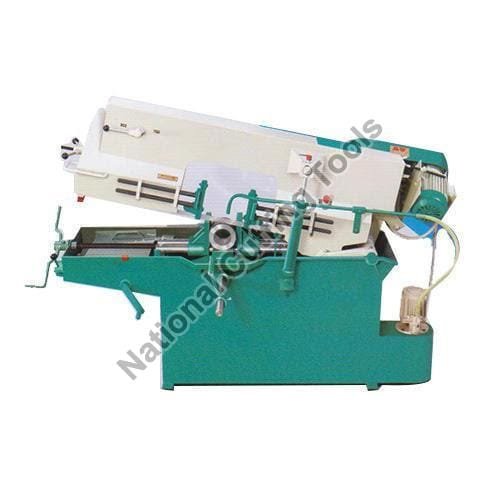
National Cutting Tools manufactures heavy-duty horizontal band saws and semi-automatic hydraulic band saw machines in Ludhiana. This guide explains how to properly configure a band saw system for high-volume manufacturing.
1. Manual vs Semi-Automatic vs Fully Automatic Band Saws
- Manual Gravity Feed Saws: The saw bow descends under its own weight regulated by a hydraulic dashpot cylinder. The operator manually loads the bar, clamps the vice, starts the motor, and raises the saw bow after the cut. Recommended for low-volume maintenance shops and jobbing units cutting fewer than 30 bars per shift.
- Semi-Automatic Hydraulic Band Saws: Push-button cycle starts the hydraulic clamping vice, powers the blade motor, activates coolant flood, and regulates progressive hydraulic downfeed. At cut completion, the blade stops automatically and the saw bow elevates to a preset height, releasing the vice. Ideal for production runs cutting structural pipes, rebar bundles, and forging billets up to 350 mm–500 mm diameter.
- Fully Automatic NC Bundle Saws: Integrates hydraulic bar feeding shuttles with NC length setting (0.1 mm repeatability) for continuous unassisted cutting of high-volume batches.
2. Bi-Metal M42 Band Saw Blade Selection
The cutting blade is a critical wear tooling component. Industrial operations must use M42 Bi-Metal blades (8% Cobalt high-speed steel tooth tips electron-beam welded to an alloy spring steel backing material). Blade life depends primarily on selecting the correct Tooth Pitch (TPI — Teeth Per Inch):
| Material Cross-Section | Recommended Pitch (TPI) | Tooth Form | Cutting Action |
|---|---|---|---|
| Solid Billet 150 mm – 300 mm | 1.4 / 2.0 Variable TPI | Positive Rake (10°) | Large gullet space prevents chip packing |
| Solid Billet 50 mm – 120 mm | 2 / 3 or 3 / 4 Variable TPI | Positive Rake (6°–10°) | Balanced penetration and tooth strength |
| Structural Tube Wall 4 mm – 12 mm | 4 / 6 or 5 / 8 Variable TPI | Straight Rake (0°) | Min. 3 teeth in contact to prevent tooth stripping |
| Thin Wall Pipe < 3 mm / Bundles | 8 / 12 or 10 / 14 Variable TPI | Reinforced Tooth | High tooth count prevents shock fracture |
3. Blade Speed & Hydraulic Downfeed Regulation
A common operator mistake is running the blade at maximum speed regardless of alloy hardness. Excess speed generates extreme frictional heat, softening tooth tips and causing premature blade dulling.
- Mild Steel (IS 2062, A36, St 37): 60 to 80 m/min blade speed.
- Medium Carbon / Alloy Steel (EN-8, EN-19, 4140): 35 to 50 m/min blade speed.
- Stainless Steel (SS 304, SS 316) & Tool Steels: 20 to 30 m/min blade speed with heavy continuous downfeed pressure to prevent work hardening.
4. Hydraulic Blade Tensioning & Guide Roller Carriages
Blade wandering (non-square, angled cuts) occurs when blade tension drops below specification or when guide arms are set too far apart:
- Hydraulic or Mechanical Tensioning: Maintain blade tension at 25,000 to 30,000 PSI (170–210 MPa). NCT band saws incorporate hydraulic tension gauges with automatic electrical interlocks that cut off motor power if blade tension drops or if a blade breaks.
- Tungsten Carbide Guide Blocks: Support the blade immediately above and below the cut with pre-aligned carbide wear pads and precision ball bearing guide rollers, ensuring cuts remain perpendicular within 0.15 mm per 100 mm depth.
- Swiveling Guide Arm: Always slide the adjustable movable guide arm within 10–20 mm of the workpiece diameter before initiating the cut.
5. Sizing for Your Production Facility
Explore models in our band saw machinery division, where capacities range from 200 mm up to 600 mm cutting diameters. We supply bundle cutting vices for scaffolding tube processors, motorized swarf brush assemblies, and complete roller infeed/outfeed conveyor tables built to handle 6-meter mill lengths.
Senior Machine Tool Design & Production Engineering Division, Ludhiana Works
Authored by machine tool builders at our Ludhiana manufacturing works. Every technical parameter, metallurgy guideline, electrical formula, and production cycle stated in this guide is reviewed by our shop-floor engineers who assemble, wire, and execute material trials before global dispatch to GCC and domestic manufacturing facilities.
Need Engineering Consultation on This Subject?
Speak directly with National Cutting Tools senior machinery engineers.