
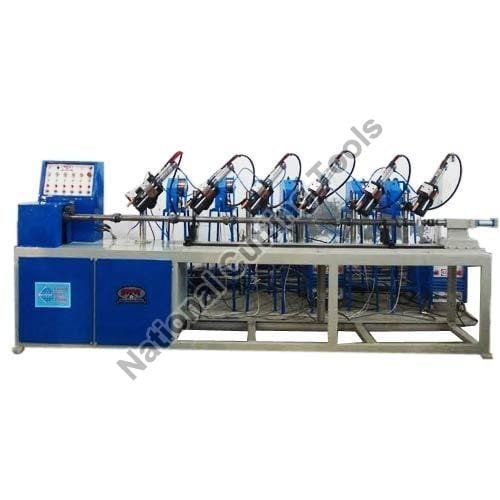
A guide for Omani construction and hire firms in Muscat and Sohar establishing automated Cuplock and prop welding lines to meet local PDO and ministry standards.
Across the Sultanate of Oman—supporting major industrial projects in Duqm Special Economic Zone, Petroleum Development Oman (PDO) concession areas, Khazaen Economic City, and municipal infrastructure across Muscat—construction companies and scaffolding rental fleets face rising demand for certified modular scaffolding. Relying on imported finished scaffolding systems incurs substantial ocean freight costs and long procurement lead times.
As a result, leading Omani structural steel fabricators and scaffolding suppliers are establishing in-house automated manufacturing lines. Replacing inconsistent manual hand welding with dedicated automatic circular MIG welding systems delivers high daily output, lower production costs, and strict compliance with BS 1139 / EN 12810 standards. This technical guide outlines the machine setup, tooling requirements, and quality control procedures for an Omani scaffolding line.
1. Critical Weld Integrity for Omani Shoring & Access Standards
Scaffolding deployed on major Omani oil and gas and civil sites must endure harsh desert conditions, heavy cyclic loading, and frequent dismantling. Manual welding creates severe quality issues:
- Inconsistent Weld Fillets: Manual welding around small pipe circumferences (48.3 mm OD) frequently results in uneven weld throat thickness and cold laps at start/stop points. Under standard axial load testing, poorly welded cups shear away from vertical standards.
- Low Daily Output: A manual welder can assemble only 60 to 80 Cuplock standards per day, creating a severe bottleneck when supplying multi-thousand-piece scaffolding contracts.
- Spatter on Threaded Sections: Manual stick or MIG welding generates heavy weld spatter that fouls prop threads, requiring labor-intensive manual thread dressing.
Dedicated scaffolding manufacturing machinery solves these bottlenecks through automated motorized rotation, pneumatic clamping, and synchronized dual-torch MIG power sources that deliver smooth, spatter-free, 360-degree weld seams.
2. Essential Machinery Setup for an Omani Scaffolding Facility
A complete scaffolding fabrication facility capable of producing Cuplock standards, ledgers, base jacks, and telescopic shoring props incorporates four primary machine stations:
A. Automatic Cuplock Standard Bottom Cup Welder
The standard Cuplock welding machine secures pressed bottom cups at exact 500 mm pitch intervals along vertical pipes up to 3 meters in length. Pneumatic indexing fixtures and automated rotary chucks ensure that each cup is welded with uniform penetration in under 30 seconds.
B. Dual-Torch Ledger End Circular Welder
The scaffolding horizontal ledger welding machine clamps the horizontal pipe and positions forged ledger blades at both ends simultaneously. Dual MIG torches strike arcs concurrently and complete both circumferential end welds in 18 to 22 seconds.
C. Outer & Inner Prop Circular Welding Stations
Adjustable telescopic shoring props require reliable joints between foot plates, threaded sleeves, and tubes. The welder outer prop welding machine and inner prop welding machine utilize pneumatic self-centering chucks and programmable torch timers for consistent circumferential welding.
D. Heavy Scaffolding Thread Rolling Unit
Adjustable base jacks and prop sleeves require durable trapezoidal threads. The scaffolding thread rolling machine cold-rolls threads onto ERW pipes without removing core metal, preserving structural wall thickness and ensuring smooth collar movement.
3. Machinery Layout & Daily Production Capacity
The table below illustrates a balanced machinery configuration for an Omani manufacturing yard producing both Cuplock and telescopic props:
| Production Station | Primary Machine Model | Output per 8h Shift | Power Requirement |
|---|---|---|---|
| Cuplock Standards | Standard Cuplock Welder | 250 – 350 standards | 400A / 415V 50Hz |
| Cuplock Ledgers | Horizontal Ledger Welder | 600 – 800 ledgers | 2x 400A / 415V 50Hz |
| Telescopic Props | Outer / Inner Prop Welder | 400 – 550 props | 400A / 415V 50Hz |
| Threaded Jack Pipes | Thread Rolling Machine | 500 – 700 threaded tubes | 7.5 kW / 415V 50Hz |
4. Electrical Standards & Ocean Shipping to Sohar & Salalah
Every machine delivered to the Sultanate of Oman is engineered for local operational realities:
- 415V 50Hz Grid Compatibility: Machinery connects directly to the standard Omani 415V, 3-Phase, 50 Hz industrial power supply without requiring voltage transformers.
- High Ambient Heat Resistance: Control cabinets integrate cooling fan ventilation and heavy-duty contactors rated for elevated ambient temperatures common in unconditioned Gulf fabrication bays.
- Sea Container Shipping: Dispatches from our works in Ludhiana, Punjab, are stuffed into dedicated 20ft or 40ft sea containers at dry ports and shipped directly to Sohar Port (3 to 4 days transit) or Port of Salalah (4 to 5 days transit). All critical surfaces receive VCI corrosion barrier treatment.
5. Factory FAT Trials & Technical Consultation
National Cutting Tools provides complete foundation plans, electrical schematics, and operator video run-off trials for every machine. We invite Omani engineering teams to visit our Ludhiana works to inspect machines in live production prior to dispatch. Explore our Oman machinery export hub, review our full scaffolding machinery line, or request a complete quotation via our engineering inquiry desk.
Machines covered in this guide
Senior Machine Tool Design & Production Engineering Division, Ludhiana Works
Authored by machine tool builders at our Ludhiana manufacturing works. Every technical parameter, metallurgy guideline, electrical formula, and production cycle stated in this guide is reviewed by our shop-floor engineers who assemble, wire, and execute material trials before global dispatch to GCC and domestic manufacturing facilities.
Need Engineering Consultation on This Subject?
Speak directly with National Cutting Tools senior machinery engineers.