
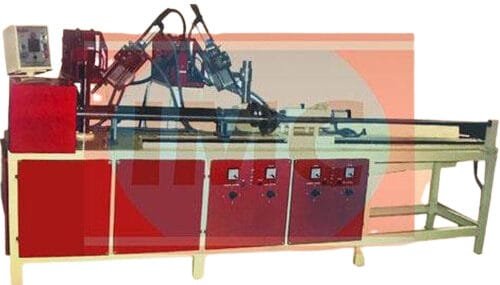
A practical engineering guide for UAE steel fabricators in Dubai, Sharjah, and Abu Dhabi evaluating automatic circular MIG welding machines for Cuplock ledgers, Ringlock rosettes, and scaffolding props under BS 1139.
Across the United States of Emirates—from Al Quoz and Jebel Ali in Dubai to Sharjah Industrial Areas and ICAD Abu Dhabi—scaffolding hire companies and structural steel fabricators face stringent safety inspections on construction access systems. With multi-story commercial towers, infrastructure viaducts, and energy facilities demanding continuous supply of heavy-duty modular scaffolding, relying solely on manual hand MIG welding creates severe structural and production bottlenecks.
This technical engineering guide examines how dedicated automatic circular MIG welding systems built by National Cutting Tools in Ludhiana solve weld consistency, cycle time limits, and compliance challenges under British and European standards (BS 1139 / EN 74 / EN 12810) commonly enforced by UAE municipal authorities and engineering consultants.
1. The Structural Challenge: Manual Welding vs. Automated Circular MIG
In high-volume scaffolding yards across the UAE, tubular ledgers and vertical standards are subject to intense cyclic loading, wind buffeting, and heavy site handling. Manual stick or manual MIG welding introduces three critical failure modes:
- Incomplete Root Penetration: Hand torches frequently leave cold laps or lack of root fusion around circular tubular joints (48.3 mm OD pipes), creating weak shear planes that fail during mandatory tensile and moment-load proof testing.
- Long Cycle Times: A skilled welder typically requires 3 to 4 minutes to manually weld both ends of a scaffolding ledger, including pipe alignment, tacking, rotation, and cleaning.
- Heat Distortion and Ovality: Uneven heat input from slow manual welding distorts tubular ends, preventing ledger blades and spigots from seating square against vertical standards.
Dedicated scaffolding manufacturing machinery eliminates these manual inconsistencies. Utilizing motorized headstock rotary chucks, pneumatic tailstock clamps, and twin synchronized MIG welding torches, an automatic scaffolding horizontal ledger welding machine completes both circumferential welds simultaneously in 18 to 22 seconds with uniform 360-degree weld penetration.
2. Essential Welding Stations for UAE Scaffolding Manufacturing
Establishing an efficient scaffolding production line capable of producing 5 to 10 metric tons of modular scaffolding per 8-hour shift requires targeted automated welding machinery:
A. Automatic Ledger End Welding System
Horizontal ledgers require high-strength circular welds securing cast or forged ledger blades to ERW steel tubes (3.2 mm to 4.0 mm wall thickness). Our ledger welding machine integrates dual water-cooled MIG power sources (400A to 500A) and PLC controls, allowing operators to set rotation speed, pre-weld gas purge, arc start dwell, and crater filling cycles for spatter-free seams.
B. Cuplock Bottom Cup & Ringlock Rosette Welding Lines
Vertical standards (props/verticals) feature nodes spaced at precise 500 mm intervals:
- Cuplock Standards: The standard Cuplock welding machine indexes tubular pipes up to 3 meters in length, clamping forged bottom cups at accurate pitch intervals and executing simultaneous circular welds.
- Ringlock Standards: The standard Ringlock welding machine secures heavy laser-cut or forged rosette plates, providing multi-torch penetration to resist high torsional stresses.
C. Telescopic Prop Inner & Outer Sleeve Welders
Adjustable scaffolding props require secure circumferential joints between base plates, threaded sleeves, and outer tubes. The welder outer prop welding machine and inner prop welding machine provide rapid pneumatic centering and automated torch tracking for leak-free, high-load joints.
3. Technical Specifications Comparison
The following table outlines standard production parameters for NCT scaffolding welding lines dispatched to the Middle East:
| Machine Type | Workpiece Range | Cycle Time | Power Rating | Primary Application |
|---|---|---|---|---|
| Ledger End Welder | 48.3 mm OD (0.5m – 3.0m length) | 18 – 22 sec (both ends) | 400A / 415V 50Hz | Cuplock & Ringlock Ledgers |
| Vertical Cup Welder | 48.3 mm OD (up to 3.0m length) | 25 – 30 sec per node | 400A / 415V 50Hz | Bottom Cup to Standard Tube |
| Outer Prop Welder | 56 mm – 60 mm OD tubes | 20 – 25 sec per pipe | 400A / 415V 50Hz | Threaded Sleeve & Foot Plate |
4. Electrical, Export Packaging & Sea Freight to UAE Ports
Machinery exported from our Ludhiana works to the UAE is built for Gulf industrial operating conditions:
- Electrical Supply: Standard 415V, 3-Phase, 50 Hz supply fully compatible with DEWA (Dubai), SEWA (Sharjah), and ADDC (Abu Dhabi) industrial grids. Tropicalized control cabinets with cooling fans withstand ambient shop-floor temperatures exceeding 45°C.
- Protective Packaging: Bare machined guideways and chucks receive multi-layer VCI (Vapor Corrosion Inhibitor) grease coatings, waterproof foil wrapping, and desiccant packs before bolting into heavy hardwood skids for sea container stuffing.
- Direct Shipping Routes: Dispatched from Ludhiana via dry-port ICD (Inland Container Depot) to Nhava Sheva (JNPT) or Mundra, sailing directly to Jebel Ali Port (Dubai), Khalifa Port (Abu Dhabi), or Port Khalid (Sharjah) with typical ocean transit times of 3 to 5 days.
5. Engineering Support & Consultation
National Cutting Tools provides complete foundation layout drawings, electrical schematics, and video run-off trials for every machine before dispatch. For comprehensive market information, review our dedicated UAE export machinery hub, browse related pipe fabrication machinery, or submit your tube diameters and daily output requirements via our engineering contact desk.
Machines covered in this guide
Senior Machine Tool Design & Production Engineering Division, Ludhiana Works
Authored by machine tool builders at our Ludhiana manufacturing works. Every technical parameter, metallurgy guideline, electrical formula, and production cycle stated in this guide is reviewed by our shop-floor engineers who assemble, wire, and execute material trials before global dispatch to GCC and domestic manufacturing facilities.
Need Engineering Consultation on This Subject?
Speak directly with National Cutting Tools senior machinery engineers.