
A practical engineering buyer guide for Indian scaffolding fabricators: comparing automatic circular MIG welding machines against manual welding, electrical specs (415V 3-Phase), GST input tax credit, and factory run-off trials in Ludhiana.
With unprecedented expansion across Indian infrastructure—spanning metro rail viaducts, elevated expressways, industrial corridors, and commercial high-rises—scaffolding fabrication yards across India are facing severe production bottlenecks. Traditional manual stick welding (MMAW) simply cannot deliver the dimensional uniformity, weld penetration, and daily output demanded by Tier-1 EPC contractors like L&T, Tata Projects, and Shapoorji Pallonji.
This technical guide provides Indian structural fabricators with a practical roadmap for evaluating and procuring dedicated scaffolding manufacturing machinery directly from machine builders in Ludhiana, Punjab.
1. The Production Bottleneck: Manual Welding vs. Dedicated Circular MIG Systems
In standard Indian fabrication yards, cuplock ledgers and vertical standards are frequently assembled using manual MIG or shielded metal arc welding. This introduces three critical failure points:
- Inconsistent Weld Penetration: Manual torch manipulation leaves cold laps and incomplete root penetration around tubular circumferences, leading to catastrophic weld shearing during site load testing under IS 1161 / IS 1239 standards.
- Excessive Cycle Times: A skilled welder takes 3.5 to 4.5 minutes to complete circular welds on both ends of a scaffolding ledger pipe, including positioning and deslagging.
- High Operator Fatigue & Rejection Rates: Maintaining continuous weld puddle uniformity across 300 to 500 pipes per shift is humanly impossible, leading to high rejection rates during client third-party inspections (TPI).
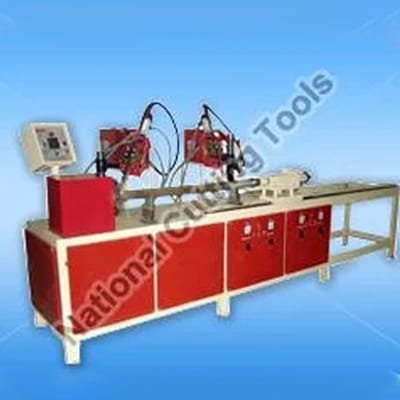
By contrast, dedicated automatic scaffolding welding machines utilize motorized rotary chucks, pneumatic end-clamping fixtures, and twin-torch synchronized MIG power sources. A dual-torch ledger welding machine completes both end welds simultaneously in 18 to 22 seconds, ensuring 100% circumferential weld penetration with zero spatter.
2. Essential Machinery Lineup for an Indian Scaffolding Manufacturing Yard
To establish an efficient scaffolding production line capable of fabricating 5 to 10 metric tons of finished Cuplock, Ringlock, or prop systems per shift, the standard machinery layout includes:
A. Precision Tube Cutting & End Preparation
Clean, square pipe end cuts with minimal burr are mandatory for robotic and automated circular welding. The semi-automatic pipe cutting machine and heavy-duty horizontal band saws handle high-volume sectioning of 48.3mm OD scaffolding tubes without wall distortion.
B. Automatic Cuplock & Ringlock Welding Stations
The core of the welding bay consists of dedicated machines engineered for specific tubular joints:
- Cuplock Bottom Cup Welding Machine: Features multi-station rotary indexing to weld pressed bottom cups at precise 500mm standard pitch centers along vertical pipes up to 3 meters in length. Explore the standard Cuplock welding machine for duty specifications.
- Ledger Blade Dual-Torch Welder: Synchronized pneumatic tailstock and headstock clamping that welds forged ledger blades to both ends of horizontal tubes simultaneously. See the ledger welding machine in operation.
- Prop Outer & Inner Sleeve Circular Welder: Heavy-duty circular welders for adjustable telescopic props, welding base plates and threaded sleeves to heavy-gauge ERW tubes. Check our inner prop welding machine and outer prop welding machine.
C. Hydraulic Stamping & Forming Presses
In-house stamping of scaffolding accessories—including top cups, bottom cups, base plates, and prop sleeves—requires rigid C-frame mechanical presses or 4-pillar deep drawing hydraulic presses. See our C-frame power press and double action deep drawing hydraulic press for blanking and cupping dies.
D. Pipe End Notching, Punching & Threading
Fabrication of base jacks and universal jacks requires high-speed thread rolling or chaser threading machines. The pipe and bar threading machinery cuts robust Acme and trapezoidal threads on solid bar jacks and hollow prop tubes.
3. Electrical, Pneumatic & Workshop Infrastructure Requirements
Before machine dispatch, Indian fabricators should prepare their shop floor utilities to ensure rapid commissioning:
| Utility | Required Specification | Engineering Rationale |
|---|---|---|
| Electrical Supply | 415 V ±10%, 3-Phase, 50 Hz | Equipped with genuine L&T or Schneider switchgear to handle voltage fluctuations common in industrial estates. |
| Pneumatic Air | 6 to 8 bar (85–115 PSI) clean dry air | Powers pneumatic clamps, pipe centering mandrels, and rapid tailstock retraction cylinders. |
| Shielding Gas | 80% Argon / 20% CO₂ (or pure CO₂) | Ar/CO₂ mix reduces weld spatter and delivers smooth bead profile required for hot-dip galvanizing. |
| Floor Foundation | 150mm reinforced concrete slab | Maintains optical leveling of machine beds to ensure true alignment on 3-meter to 6-meter vertical pipes. |
4. Commercial Realities: GST Invoicing, E-Way Bills & Capital Subsidy
Procuring directly from an established Ludhiana manufacturer provides distinct financial and compliance safeguards:
- 18% GST Input Tax Credit (ITC): Capital machinery attracts 18% GST under HSN 8468 (welding equipment) or HSN 8462 (hydraulic presses). A valid GST tax invoice allows Indian fabricators to claim 100% ITC against their finished scaffolding output tax liability.
- Computerized E-Way Bill & Transit Insurance: All dispatches from Ludhiana are accompanied by portal-generated E-Way bills and comprehensive all-risk transit insurance, protecting your capital investment during highway transit.
- State & Central MSME Incentives: Machines built by certified ISO 9001 manufacturers qualify for state capital investment subsidies and MSME technology upgradation credit schemes.
5. The Ludhiana Pre-Dispatch Trial Run (FAT Protocol)
Never purchase tubular welding machinery purely from catalog photographs or dealer claims. At National Cutting Tools, we invite every buyer—or their deputed engineering team—to our Ludhiana works for mandatory Factory Acceptance Testing (FAT):
- Raw Material Verification: The client supplies 10 to 20 samples of their actual job site ERW pipes, forged cups, or ledger blades.
- Full-Speed Production Trial: The machine is loaded, clamped, and run at standard production cycle times to verify cycle speed, weld bead uniformity, and pneumatic clamping force.
- Weld Integrity Check: Test specimens are sectioned and etched to verify 100% root fusion in accordance with BS 1139 and EN 74 requirements.
- Crating Sign-Off: The machine is cleaned, coated with anti-corrosion barrier grease, and secured on heavy hardwood skids only after the buyer issues formal dispatch clearance.
For technical consultations, custom tube diameter tooling inquiries, or visiting our Ludhiana works, contact our engineering desk through our contact page or explore our comprehensive India domestic supply network.
Machines covered in this guide
Senior Machine Tool Design & Production Engineering Division, Ludhiana Works
Authored by machine tool builders at our Ludhiana manufacturing works. Every technical parameter, metallurgy guideline, electrical formula, and production cycle stated in this guide is reviewed by our shop-floor engineers who assemble, wire, and execute material trials before global dispatch to GCC and domestic manufacturing facilities.
Need Engineering Consultation on This Subject?
Speak directly with National Cutting Tools senior machinery engineers.