
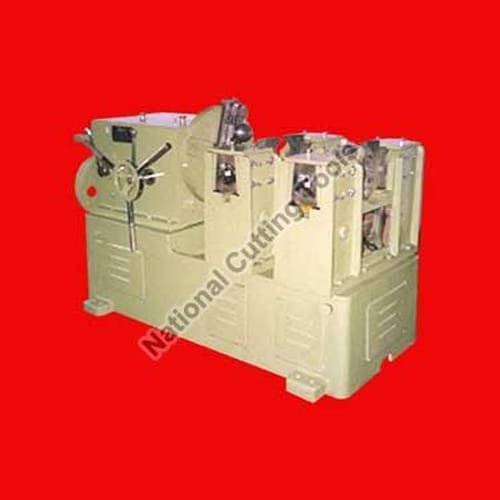
An engineering walkthrough on specialized pipe fabrication lines. Covers multi-spindle tube drilling for scaffolding props, hydraulic pipe swaging and end reduction, cold circular sawing, and end facing for industrial tubular manufacturing.
Automated Tubular Fabrication Machinery for Scaffolding and Structural Lines
Tubular steel fabrication—including scaffolding prop production, structural space frames, greenhouse trusses, automotive exhaust systems, and industrial fence lines—requires high-speed, repeatable secondary operations. Cutting, end-forming (swaging/expanding), hole drilling, and pipe end beveling cannot be performed economically using general-purpose manual tools when contract volumes demand thousands of tubular components per day.
National Cutting Tools designs and builds custom multi-spindle pipe drilling machines, hydraulic pipe end-forming swaging machines, and automated pipe facing systems in Ludhiana. This guide outlines how integrated specialized pipe machinery streamlines manufacturing throughput.
1. Multi-Spindle Pipe Drilling vs Single-Hole Punching
Scaffolding inner props (typically 48.3 mm OD × 2.5 mm / 3.2 mm wall × 2000 mm to 3500 mm length) require through-holes drilled along their length at precise 100 mm pitch intervals to accommodate adjusting G-pins.
Fabricators who attempt to punch these holes on standard mechanical presses encounter two major quality defects:
- Tube Wall Crushing: Punch entry deforms the round tube profile into an oval shape, preventing the inner prop from telescoping smoothly inside the 60.3 mm outer tube.
- Heavy Internal Burrs: Punched holes leave sharp jagged internal burrs that jam the safety adjusting pin during site erection.
Our Multi-Spindle Pipe Drilling Machine solves both issues by drilling through both pipe walls simultaneously from opposite directions or using gang-drilling spindle clusters. Multiple hardened HSS drill spindles run in synchronized precision gearboxes, producing clean, round, burr-free through-holes at exact center-to-center pitch distances in under 40 seconds for an entire 3-meter tube.
2. Hydraulic Pipe End Swaging, Expanding & Reducing
Tubular connections frequently require one pipe end to sleeve into another without welding on separate coupling sleeves:
- End Reduction (Swaging): A hydraulic ram drives an outer hardened tool steel die over the heated or cold tube end, reducing the outer diameter (e.g., from 48.3 mm to 42 mm) over a 100 mm to 150 mm length. Used for cuplock standards, prop spigots, and modular frame scaffolding leg connections.
- End Expansion: An internal segmented expanding mandrel forces the pipe end outward, creating a socket connection for slip-fit plumbing and exhaust tubing.
- End Flaring and Beading: Forms a 90° retaining lip or circumferential locating bead on the tube end to lock flange rings or clamp collars.
NCT hydraulic swaging machines feature clamping tonnages up to 60 tons and axial thrust forces up to 40 tons, processing structural steel tubes up to 4.5 mm wall thickness in cold forming cycles of 6 to 10 seconds per end.
3. Cold Circular Sawing vs Abrasive Cutting
When preparing tubular ends for robotic welding or automated swaging, cut squareness and edge condition are paramount:
| Feature | Abrasive Chop Saw | HSS Cold Circular Sawing Machine |
|---|---|---|
| Cut Squareness | ±1.5° (blade deflection common) | Perpendicular within ±0.1° |
| Heat Affected Zone (HAZ) | Severe blue heat tint; hardened edge | Zero heat tint; cold milled finish |
| Burr Generation | Heavy molten flash requiring manual grinding | Minimal fine burr, immediately ready for welding |
| Automated Welding Fit-up | Gaps require excessive weld filler wire | Zero-gap joint fit for robotic MIG torches |
4. Pipe End Facing & Chamfering Lines
Prior to butt welding pipe lengths or rolling threads, pipe ends must be faced square to length and chamfered (30° / 37.5° welding bevel or 45° deburring chamfer). NCT automatic pipe end facing machines utilize twin cutter heads that simultaneously face, chamfer the outside diameter (OD), and ream the inside diameter (ID) in a single 4-second pneumatic/hydraulic clamping cycle.
5. Turnkey Plant Integration
Explore complete equipment profiles in our specialized pipe machinery division. National Cutting Tools engineers complete synchronized production lines—integrating cold cut-off saws, end swaging presses, multi-spindle drilling rigs, and automated MIG welding rotators—engineered to manufacture BS 1139 and EN 74 compliant scaffolding systems for domestic infrastructure and global export markets.
Machines covered in this guide
Senior Machine Tool Design & Production Engineering Division, Ludhiana Works
Authored by machine tool builders at our Ludhiana manufacturing works. Every technical parameter, metallurgy guideline, electrical formula, and production cycle stated in this guide is reviewed by our shop-floor engineers who assemble, wire, and execute material trials before global dispatch to GCC and domestic manufacturing facilities.
Need Engineering Consultation on This Subject?
Speak directly with National Cutting Tools senior machinery engineers.