
Voltage, port of discharge, transit time, packing and documentation for machinery landing at Jebel Ali, and how to specify a machine so it runs correctly on a UAE site.
The UAE imports most of its production machinery, and the fabrication yards around Dubai, Sharjah and Abu Dhabi buy scaffolding, threading and press equipment continuously. The machines themselves are the easy part. What separates a smooth import from an expensive one is what gets specified before the order is confirmed.
1. Build the machine for the site's electricity
Industrial supply in the UAE is commonly 380–415 V, three phase, 50 Hz. State the voltage and frequency with your order so motors, starters, transformers and welding equipment are ordered to match. A machine wound for a different frequency will run at the wrong speed, which changes cycle time and loads the gearbox differently.
Also state whether your site uses a generator. Generator supply varies more than grid supply, and it is worth specifying motor starting arrangements accordingly.
2. Choose the port, and know the transit
Most machinery for Dubai and the northern emirates discharges at Jebel Ali. Sea transit from the western Indian ports we ship through — Mundra, Nhava Sheva and Kandla — is short by international standards, typically in the region of four to seven days port to port, with sailing frequency good enough that scheduling is rarely the constraint. Inland haulage from Jebel Ali to a yard in Sharjah or Ras Al Khaimah then adds a day or so.
Details for the market, including the electrical build and the ports we ship to, are on our UAE market page.
3. Decide the Incoterm deliberately
| Term | You take over | Suits |
|---|---|---|
| EXW | At the works in Ludhiana | Buyers with their own Indian freight forwarder |
| FOB | Once loaded at the Indian port | Buyers with a contracted shipping line |
| CIF | On arrival at Jebel Ali | First orders, and buyers who want one landed price |
CIF is usually simplest for a first purchase because freight and insurance are inside one quotation.
4. Packing for a sea crossing and a hot yard
- Seaworthy packing with the machine bolted to its base, not merely strapped.
- Heat treated timber marked to ISPM-15 where wooden crates are used.
- Desiccant and wrapping for control panels; humidity on deck is hard on switchgear.
- Machined surfaces protected against corrosion for the crossing.
- Crate marked with gross weight, lifting points and centre of gravity.
5. Documents
Commercial invoice, packing list, bill of lading and certificate of origin travel with every consignment. Ask your customs broker in advance whether the specific machine needs any conformity or inspection certificate, because arranging one after shipment is slow and costly. If you are importing into a free zone, confirm the consignee details on the bill of lading before it is issued — corrections after issue cost money.
6. Specify for the working conditions
Ambient temperature in a UAE yard is high for much of the year, and dust is constant. Worth specifying:
- Enclosure rating on the control panel, and a panel cooling arrangement where the machine stands in direct sun.
- Hydraulic oil grade suited to high ambient temperature, and adequate tank capacity for continuous running.
- Filtration on hydraulics and on compressed air, since dust ingress is the commonest cause of early valve trouble.
7. Commission with a checklist
- Check supply voltage and phase rotation before first start.
- Confirm the machine is level and grouted where required.
- Run the first pieces on your own material and gauge them.
- Record cycle times achieved, and compare them with the quotation.
- Log oil level, temperature and pressure readings as a baseline.
What UAE buyers usually order
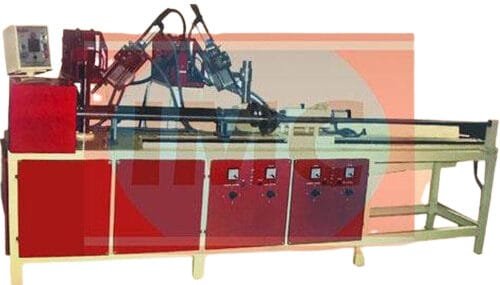
Scaffolding fabricators in the emirates typically buy scaffolding welding machinery for cuplock and ringlock systems together with prop and jack production. Pipe and structural workshops buy threading machines and pipe end facing machines. Rebar yards supplying the construction market buy rebar processing machinery for coupler production.
Frequently asked questions
How long does delivery to the UAE take?
Build time plus sea transit. Transit from western India to Jebel Ali is short — in the region of four to seven days — so the build schedule usually dominates. Ask for both separately.
Can you supply machines wired for 60 Hz?
Yes, when specified with the order. UAE industrial supply is normally 50 Hz, but tell us if your site differs.
Do you support installation in the UAE?
Tell us at the quotation stage what support you need, so it is agreed in writing rather than assumed. Most machines are straightforward to set up with the documentation and a run-off recording.
Can I see the machine running before it ships?
Yes. Machines are run on real material before crating, and we can record the run on your bar or tube size. See the machine videos.
Send your component, material sizes, output per shift and your supply voltage, and we will quote the machine built for a UAE site, delivered to Jebel Ali. See the UAE page or contact the export desk.
Machines covered in this guide
Senior Machine Tool Design & Production Engineering Division, Ludhiana Works
Authored by machine tool builders at our Ludhiana manufacturing works. Every technical parameter, metallurgy guideline, electrical formula, and production cycle stated in this guide is reviewed by our shop-floor engineers who assemble, wire, and execute material trials before global dispatch to GCC and domestic manufacturing facilities.
Need Engineering Consultation on This Subject?
Speak directly with National Cutting Tools senior machinery engineers.