
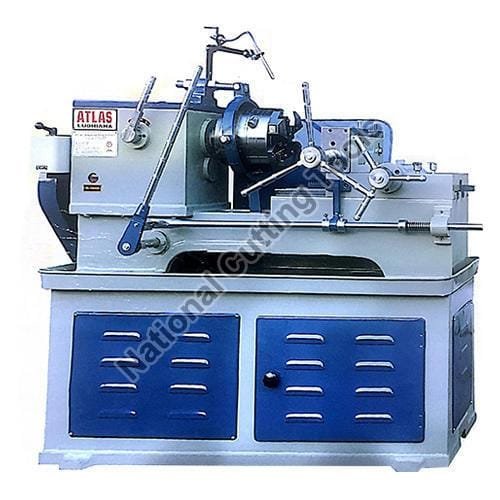
An industrial guide on heavy-duty pipe and bolt threading machines. Compares tangential vs radial chaser die heads, lead screw pitch control, spindle gearboxes, and threading standards (BSPT, NPT, Metric, Acme) for scaffolding and oilfield pipelines.
Industrial Pipe and Bolt Threading Technology
Threaded connections on galvanized water pipes, fire-fighting sprinkler pipelines, oilfield tubing, electrical conduit lines, scaffolding jack props, and high-tensile anchor bolts require accurate thread geometry, pitch consistency, and leak-free pressure seating. While light portable die stocks serve on-site emergency repairs, industrial fabrication facilities require stationary, heavy-duty pipe and bolt threading machines capable of continuous multi-shift production.
National Cutting Tools manufactures hydraulic pipe and bolt threading machines and lead screw heavy-duty threading machines in Ludhiana. This guide explains how to select the right die head, feed drive, and chaser tooling for high-volume manufacturing.
1. Die Head Configurations: Tangential Chasers vs Radial Dies
The die head assembly is the primary cutting interface. Industrial machine shops must distinguish between two fundamental die formats:
- Radial Chaser Die Heads: Chasers enter the pipe radially (towards the center). Compact and economical for smaller pipe diameters (1/2" to 2"). However, radial chasers must be ground across their entire profile when resharpening, resulting in shorter tool life and higher consumable tooling cost.
- Tangential Chaser Die Heads: The chaser blocks are mounted tangentially along the circumference of the rotating spindle. This configuration provides 3 major operational advantages:
- Extended Tooling Life: Resharpening requires grinding only the front chamfer/lead angle, allowing each chaser to be resharpened up to 25–35 times before disposal.
- Superior Chip Clearance: Heavy metal chips flow tangential to the cut, preventing chip entrapment and thread tearing on tough structural alloys.
- Adjustable Pitch Diameter: The die head features a calibrated micrometer lever that opens automatically upon reaching the preset thread length, preventing thread gouging upon machine reversal.
2. Lead Screw Control vs Manual Carriage Pull
For pressure-tight NPT/BSPT tapered pipe threads or scaffolding prop square threads, pitch accuracy across long engagement lengths is critical:
| Feature | Manual / Rack-and-Pinion Carriage | Precision Lead Screw Feed System |
|---|---|---|
| Pitch Control | Dependent on chaser pulling itself into metal | Mechanically geared lead screw drives carriage at exact thread pitch |
| First Thread Form | Risk of thin or stripped entry thread | Perfect entry thread geometry from the very first rotation |
| Best Suited For | Short standard conduit and BSP pipe nipples | Scaffolding jack props, Acme screws, tie rods, anchor bolts |
| Operator Fatigue | Moderate to high on heavy pipe sizes | Zero — automatic motorized lead screw engagement |
3. Thread Standards and Geometric Profiles
NCT threading machines handle multiple global pipe and fastener thread geometries through rapid chaser set changes:
- BSPT (British Standard Pipe Taper — ISO 7/1): 55° thread angle, 1:16 taper ratio. Standard for plumbing, fire sprinkler systems, and gas pipelines across India, the UK, Europe, UAE, and GCC.
- NPT (National Pipe Taper — ANSI/ASME B1.20.1): 60° thread angle, 1:16 taper ratio. Standard for American oilfield equipment, hydraulic manifolds, and export equipment bound for US-standard infrastructure.
- Metric Coarse / Fine (ISO 68-1 / 261): 60° thread angle. Applied to high-tensile structural bolts, foundation studs, and machine tie rods (M12 up to M75).
- Square / Acme / Trapezoidal (DIN 103): Heavy square and rounded thread profiles used on scaffolding adjustable base jacks, U-head jacks, and construction formwork tie rods.
4. Clamping Vices and Anti-Distortion Jaws
When threading thin-wall pipe (ERW structural tubes under 3 mm wall thickness), standard two-jaw serrated vices can crush the pipe out of round, causing eccentric, non-uniform thread depths. NCT machines feature self-centering, heavy-duty prismatic vice assemblies with full-contour wrap-around jaw inserts that distribute clamping pressure evenly, preventing pipe distortion while withstanding full motor cutting torque.
5. Factory Sizing & Export Supply
Explore capacities in our threading machinery division, from compact 2-inch production lines up to heavy 6-inch and 8-inch industrial pipe threading machines. Export packages include full sets of HSS M2/M35 tangential chasers, thread pitch gauges, automatic lubrication gearboxes, and dual-voltage (380V/415V/440V, 50/60 Hz) TEFC electric motors for global job site operations.
Machines covered in this guide
Senior Machine Tool Design & Production Engineering Division, Ludhiana Works
Authored by machine tool builders at our Ludhiana manufacturing works. Every technical parameter, metallurgy guideline, electrical formula, and production cycle stated in this guide is reviewed by our shop-floor engineers who assemble, wire, and execute material trials before global dispatch to GCC and domestic manufacturing facilities.
Need Engineering Consultation on This Subject?
Speak directly with National Cutting Tools senior machinery engineers.