
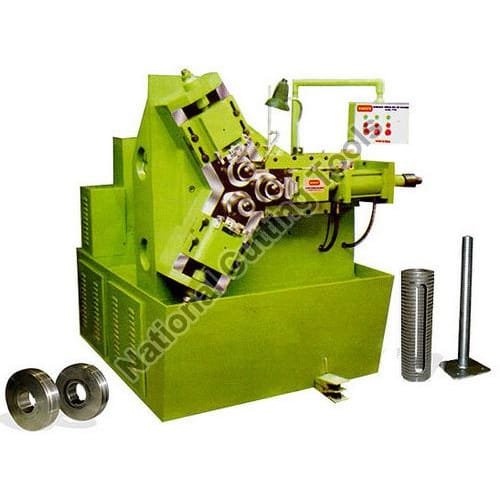
Engineering protocol for increasing chaser roller lifespan from 800 threads to 2,500+ threads per set on 16mm-40mm high-yield reinforcement bars.
Maximizing Rebar Roller Die Life
Threading high-tensile rebar (Fe500D, ASTM A615 Grade 60/75, BS 4449 Grade B500B) subjects cold rolling rollers to extreme surface pressures. Using the Rebar Thread Rolling Machine correctly requires understanding the mechanical interplay between outer rib peeling and subsequent roller thread forming.
Three-Stage Operation Sequence
- Rib Peeling Phase: Carbide peeling blades remove external longitudinal and transverse lugs down to bar core diameter within +/- 0.15mm tolerance.
- Lead Chamfer: The peeling head creates a 15-degree lead chamfer so rolling dies engage gradually without chipping thread crests.
- Cold Roll Forming: Three synchronized hardened alloy steel rollers (Cr12MoV / D2) advance under coolant to roll parallel metric threads.
| Rebar Size | Recommended Spindle RPM | Coolant Concentration |
|---|---|---|
| 16 mm - 20 mm | 65 - 80 RPM | 10% Water-Soluble Emulsion |
| 25 mm - 32 mm | 50 - 62 RPM | 12% High-Pressure Soluble Oil |
| 36 mm - 40 mm | 38 - 45 RPM | 15% Extreme-Pressure (EP) Coolant |
For high-volume coupler splicing on major civil infrastructure projects, also explore our heavy-duty Rebar Threading Machine line.
Machines covered in this guide
Senior Machine Tool Design & Production Engineering Division, Ludhiana Works
Authored by machine tool builders at our Ludhiana manufacturing works. Every technical parameter, metallurgy guideline, electrical formula, and production cycle stated in this guide is reviewed by our shop-floor engineers who assemble, wire, and execute material trials before global dispatch to GCC and domestic manufacturing facilities.
Need Engineering Consultation on This Subject?
Speak directly with National Cutting Tools senior machinery engineers.