
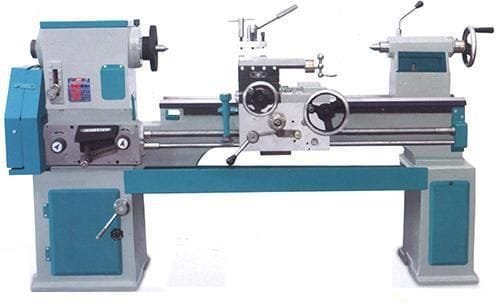
Swing, centre distance and spindle bore decide what a lathe can hold. A guide to heavy duty, geared, planer bed and semi-automatic lathes, and how to match one to your work.
Nearly every fabrication shop owns a lathe, and nearly every shop has at least one job it cannot do because the lathe was bought on price rather than on four dimensions. This guide explains what those dimensions mean, and which type of lathe suits which work.
The four numbers that decide what fits
| Specification | What it limits |
|---|---|
| Swing over bed | The largest diameter that will rotate over the bed ways. Quoted as a diameter, not a radius. |
| Swing over cross slide | The largest diameter you can actually machine with the tool post in place. Always smaller than swing over bed, and the figure that matters for flanges and discs. |
| Distance between centres | The longest shaft you can hold between the headstock and tailstock centres. |
| Spindle bore | The largest bar that can pass through the headstock. This is what decides whether you can feed pipe or bar stock through rather than working piece by piece. |
Spindle bore is the one most often overlooked. A shop turning pipe ends or threading long bar is limited far more by bore than by swing, and no amount of motor power compensates for it.
Types of lathe and what each is for
Heavy duty lathe
A wide, deeply ribbed bed, a large spindle bore and a strong gearbox for heavy cuts in steel. This is the machine for roll turning, shaft work, large flanges and any job where the cut is interrupted or the material is tough. See the heavy duty lathe machine.
Geared head lathe
Speeds are changed through a gearbox rather than by moving a belt, which keeps torque available at low speed and makes speed changes quick. A horizontal geared lathe is the general-purpose choice for a mixed jobbing shop.
Planer type bed lathe
The bed is wider under the headstock, so larger diameters clear the ways. Chosen when parts are big in diameter relative to their length — pulleys, wheels, large flanges. See the planer type bed lathe.
Medium duty lathe
Lighter construction for general turning, tool room work and maintenance jobs where cuts are modest. A medium duty lathe costs less and takes less floor space, but will chatter if pushed into heavy roughing.
Semi-automatic lathe
Where the same part is produced repeatedly, a semi-automatic lathe runs a pre-set cycle so the operator loads, starts and unloads. Cycle time becomes consistent, which is what makes output per shift predictable.
Matching the lathe to the work
- Long shafts: centre distance first, then a steady rest. Check the tailstock quill diameter and travel.
- Pipe and tube: spindle bore first. Confirm the chuck jaws suit thin wall without crushing it.
- Large discs and flanges: swing over cross slide, and a planer type bed if the diameter is close to the limit.
- Threading: check the pitches the gearbox provides, whether metric and imperial both need a change gear, and whether a thread dial indicator is fitted.
- Repeat production: semi-automatic cycle, bar feed if the bore allows, and quick change tooling.
Rigidity, and why it decides surface finish
Chatter is almost always rigidity, not tooling. When comparing two machines of the same swing, look at:
- Bed weight and rib pattern — a heavier casting absorbs cutting vibration.
- Ways: hardened and ground surfaces hold accuracy far longer than plain cast ways.
- Headstock bearing arrangement and spindle nose type.
- Saddle bearing length on the bed: a short saddle lifts under heavy cuts.
A lighter machine can be made to produce good work by reducing depth of cut, but the output per shift falls with it, which is rarely accounted for in the price comparison.
Power supply and installation
Specify the supply when ordering: most export machines are wired for 380–415 V three phase at 50 or 60 Hz, and the motor, starter and coolant pump must all match. Plan the foundation as well — a heavy lathe needs a level, solid floor and space at both ends for the longest bar you intend to load, not just for the machine itself.
Accuracy checks on delivery
- Level the bed with a precision level in both planes before any test cut.
- Turn a test bar between centres and measure at both ends: taper indicates headstock alignment or an out-of-line tailstock.
- Face a disc and check for concavity with a straight edge.
- Run a dial indicator on the spindle nose to check runout.
- Cut a thread and check the pitch over a measured length.
These five checks take under an hour and settle most acceptance questions before the machine goes into production.
Frequently asked questions
What size lathe do I need?
Take your largest part's diameter and length, add clearance for chuck jaws and a live centre, and choose the machine whose swing over cross slide and centre distance exceed those figures. Buying to the exact size of today's largest job leaves nothing for tomorrow's.
Is a geared head lathe better than a belt drive?
For steel work, generally yes: torque stays available at low spindle speeds and speed changes take seconds. Belt drive machines run quieter and suit lighter, higher speed work.
Can a lathe thread pipe?
It can, but a dedicated pipe threading machine is faster and more repeatable for production quantities, and it does not tie up the lathe.
What maintenance keeps a lathe accurate?
Clean and oil the ways daily, keep swarf out of the saddle and cross slide, check gearbox oil level weekly, and re-level the machine after any shift in the floor. Most accuracy loss comes from grit on unprotected ways.
Tell us the largest diameter and length you turn, the bar or pipe size you want to pass through the spindle, and your supply voltage, and we will quote the size of machine that fits the work. Browse the lathe machine range or send your requirement.
Machines covered in this guide
Senior Machine Tool Design & Production Engineering Division, Ludhiana Works
Authored by machine tool builders at our Ludhiana manufacturing works. Every technical parameter, metallurgy guideline, electrical formula, and production cycle stated in this guide is reviewed by our shop-floor engineers who assemble, wire, and execute material trials before global dispatch to GCC and domestic manufacturing facilities.
Need Engineering Consultation on This Subject?
Speak directly with National Cutting Tools senior machinery engineers.