
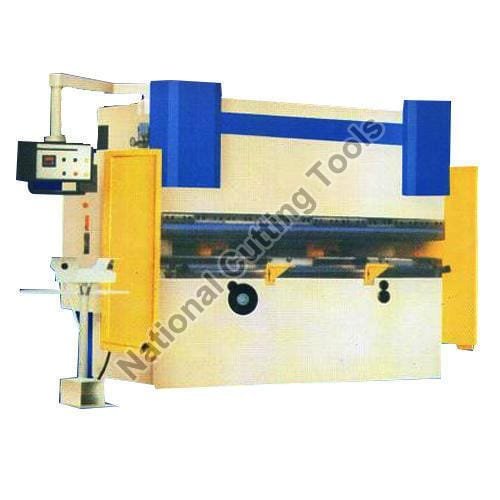
A hydraulic press gives full force anywhere in the stroke, which is why drawing, straightening and pressing work belongs on one. How to size tonnage, stroke, daylight and cycle time.
The defining feature of a hydraulic press is simple: it can deliver its full rated force at any point in the stroke, and hold it there. A mechanical press cannot. That single difference decides which operations belong on which machine, and it is the right place to start when specifying one.
Where a hydraulic press earns its place
- Deep drawing — force is needed throughout a long stroke, and the blank holder must hold steady pressure while the punch travels.
- Straightening — shafts, beams and fabricated frames, where the operator needs to creep up on the correction.
- Press fitting — bearings, bushes and pins, where controlled speed matters more than cycle time.
- Bending and forming plate — on a press brake arrangement, where the ram must dwell at depth.
- Moulding and bonding — where pressure has to be held for a set time.
Conversely, high-rate blanking and piercing belong on a mechanical power press, which returns more strokes per minute for the same money.
Specifying the machine
Tonnage
For drawing, force is driven by the blank diameter, material thickness and the drawing ratio, plus the blank holder force. For press fitting it is comparatively small. For straightening it depends on section modulus and how far the piece must be over-bent. State the operation when asking for a quotation; a tonnage figure without the operation behind it is a guess.
Allow headroom, but not excessive headroom: an oversized cylinder on an undersized pump gives a slow machine.
Stroke and daylight
Daylight is the opening between the ram face and the bed with the ram fully retracted. Your tooling, the part and any ejector must fit inside it. Stroke is how far the ram travels. Deep drawn parts need both figures generously; a press with adequate tonnage but insufficient daylight cannot be used at all.
Table size and tie rods
Check the working table dimensions against your die, and whether the frame is a C frame with three-sided access or a four-column type. Four-column frames keep the ram parallel under off-centre loads, which matters when the tool is not centred on the table.
Cycle time
Cycle time is set by the pump flow, not by the tonnage. Ask for approach, pressing and return speeds separately. A well specified machine moves fast in approach, slows to the pressing speed under load, and returns fast. If output per shift matters, this three-part figure tells you more than the headline tonnage.
Types you are likely to be choosing between
| Type | Typical use |
|---|---|
| Hand operated hydraulic press | Maintenance work, bush and bearing fitting, occasional straightening. No power supply needed. |
| Electric hydraulic press | General workshop pressing and straightening with a powered pump for repeatable force. |
| Power operated hydraulic press | Production pressing where cycle repeats all shift. |
| Double action deep drawing press | Drawn components such as scaffolding cups: the outer slide holds the blank, the inner slide draws it. |
| Hydraulic brake press | Bending sheet and plate to a set angle along a line. |
Why double action matters for drawn parts
When a flat blank is drawn into a cup, the flange has to be held down or it wrinkles. A single acting press can only push the punch; the blank holder must come from springs or a die cushion, and its force varies through the stroke. A double action press has a separate blank holder slide with its own regulated pressure, so hold-down force stays where it was set. For deeper draws and thinner material, this is the difference between a good part and a scrap rate.
The hydraulic system itself
What to check before ordering:
- Pump and motor rating, and whether there is a separate fast-approach pump.
- Working pressure and the relief valve setting, which together give the real available tonnage.
- Oil tank capacity and cooling. Continuous production heats oil; hot oil thins, leaks and loses efficiency.
- Seal specification on the main cylinder, and whether seal kits are available locally.
- Filtration, with a serviceable return line filter. Most hydraulic failures are contamination.
- Controls: pressure gauge, adjustable pressure switch, stroke limit setting and a two-hand start where the tool area is open.
Safety
A hydraulic press holds energy even when stopped. Specify guarding around the tool area, two-hand controls for hand-fed work, and a means of blocking the ram mechanically for tool changes. An emergency stop must dump the cylinder safely rather than trap pressure.
Installation and supply
Confirm the electrical build for your site — commonly 380–415 V three phase at 50 or 60 Hz for export markets — and check the machine height against your shed clearance, particularly with a four-column frame and its raised cylinder. Presses are top-heavy; they need level, solid flooring and lifting points identified before delivery.
Frequently asked questions
Hydraulic or mechanical press for scaffolding cups?
Cup pressing is a drawing operation, so a hydraulic press, ideally double action, gives better control of wrinkling and thinning. Blanking the disc that becomes the cup is better done on a mechanical press.
How do I calculate the tonnage for deep drawing?
Drawing force depends on blank diameter, thickness, material strength and the draw ratio, and the blank holder adds its own requirement. Send the part drawing and material specification to the machine builder rather than relying on a rule of thumb.
Why is my press slower than the quoted cycle?
Almost always pump flow, oil temperature or a relief valve set below rated pressure. Check oil level and temperature first.
What maintenance does a hydraulic press need?
Oil condition and level, filter changes at the stated interval, hose inspection for chafing, and cylinder seal checks. Keep a log; oil analysis is cheaper than a cylinder rebuild.
Send the operation, part drawing, material and thickness, the cycle you need and your supply voltage, and our Ludhiana works will specify tonnage, stroke and daylight for it. Browse the hydraulic press range or talk to the engineering desk.
Machines covered in this guide
Senior Machine Tool Design & Production Engineering Division, Ludhiana Works
Authored by machine tool builders at our Ludhiana manufacturing works. Every technical parameter, metallurgy guideline, electrical formula, and production cycle stated in this guide is reviewed by our shop-floor engineers who assemble, wire, and execute material trials before global dispatch to GCC and domestic manufacturing facilities.
Need Engineering Consultation on This Subject?
Speak directly with National Cutting Tools senior machinery engineers.